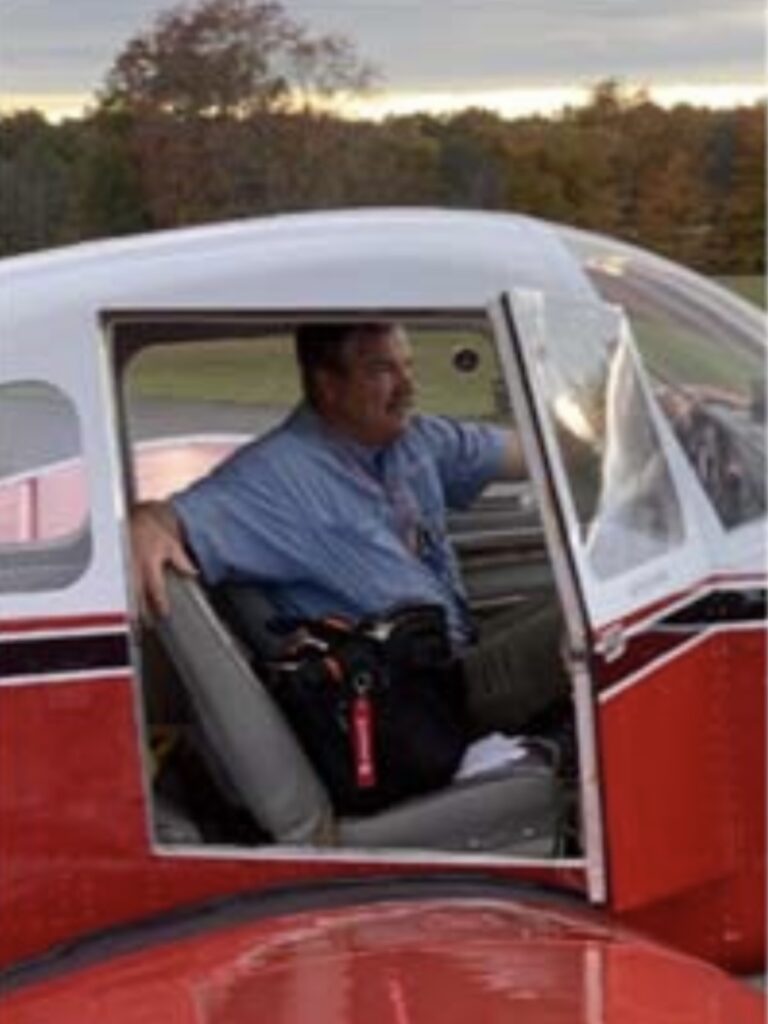
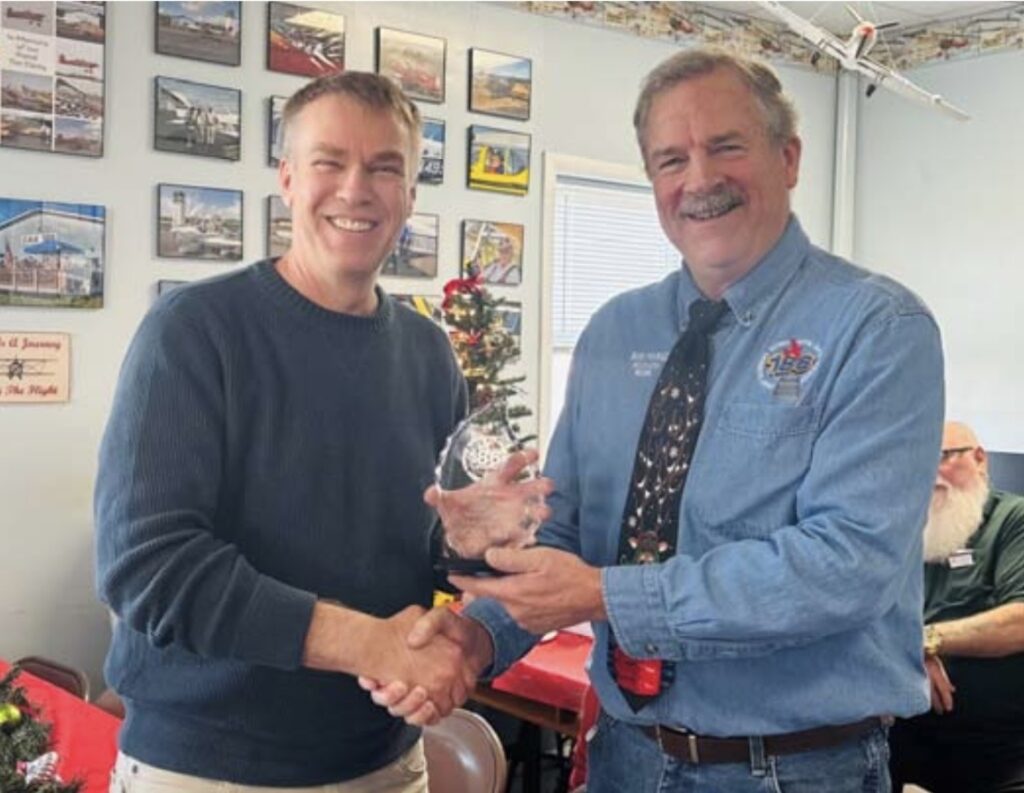
From a Former Ray Scholar from Tony Crupi

Hello again, EAA 186!

Last I wrote to you, I was alternating cooking in the Pawnee cockpit and backflipping gliders over the Arizona desert. This was in my effort to collect a daunting 1,500 hours of total time in order to qualify for an Airline Transport Pilot certificate.

During this chase, I had applied to every “cadet program” associated with any airline that had a place to slide an application through the mailbox attached to or not. Through my tour of each application process, I learned that some airlines in 2023 were serious about handing out interviews, some were interested but overwhelmed by industry changes, and the rest either did not care or were outright rude. Frontier only accepted applications from instructors who were graduates of ATP Flight School—good luck with a completely isolated labor base, I suppose. SkyWest made you one of their cadets if you gave them your email, but their interview was “worse than an instrument and commercial checkride combined” and they would tell you they “weren’t really looking for anyone that was not outright impressive” shortly before it. Spirit was utterly faking their process and a short while later surfaced the issue of all now-known-about. Envoy could not give out class dates on time, and PSA’s team went unresponsive for long enough that their cadets just started leaving for other airlines. Those PSA cadets couldn’t even figure out how to return their bonuses. Southwest cadets have it possibly the worst; a 737 SIC rating guaranteed to each one of them, but no timeline to be found… after paying Southwest themselves for $100,000 of training at their “225” program.

Republic liked me but sentenced their entire future pilot base to a five-year commitment with shaky promises shortly after my successful cadet interview. Piedmont, initially unresponsive to applications for months at a time, would at least answer emails and let you know they were working on things.

I intended to win the Piedmont Airlines slot. I favored their routes all over my East Coast homeland and their old hardware, the Embraer 145. Additionally, I wanted to be part of a smaller company. With 800–1000 pilots at the time, PDT was perfect. I submitted my application to their CJO program the day I hit 400 hours total time, the bare minimum one was allowed to apply, which would turn out to be the best decision of my life. Six months after applying to Piedmont, they shot me an email while I was in a thermal over AZ Route 238. I cheered at its contents—an interview offer.

Intense studying of the interview recounts on the aviation interview websites prepared me quite well for the early interview. At 750 hours, as a CFI-G and multi-engine commercial pilot only, they offered me a conditional job offer to be a First Officer on the E145. I was in total disbelief.

Now, even if you bend a couple rules, it’s quite difficult to finish up 100 hours of night flying in gliders. The required 75 hours of instrument time would be both illegal AND impressive. I did some math and realized I had to collect these hours elsewhere, and that I sure couldn’t pay for them out of pocket.

Luckily, I had completed my CFI-Airplane Single Engine Land on my own during the glider teaching and towing. This was mostly to be legally able to teach my friends but ended up being quite necessary to secure a job instructing with the University of North Dakota. One might think I would have needed to exchange my desert-approved short-shorts for long johns during this frigid four-year span north of my dried-out carcass, but that was not the case. UND opened shop outside of the former military base at KIWA, Mesa-Gateway several years prior.

This is where they seem to do much of their business and must be confusing for the public. UND handles their own for-profit aviation instruction, that of local community colleges, military contracts, and a few international partnerships. Each of these student bases varied wildly in student quality and capability. There were seldom days that bored me.

The community college students could only fly three or so times per week and you had to build your schedule around them entirely. The fight to keep them not only proficient, but learning was intense and only the strongest survived while doing their degree.

The international partnerships—groups of entirely Chinese men—had been ordered by their government to succeed or be sent home as a ground handler for the rest of their lives. This was not a joke, and we were briefed on this during our instructor indoctrination. Our UND superiors phrased our part in the system as “giving these men an opportunity to bring themselves and their families out of possible poverty.” While I disagreed with giving away our skills and knowledge to the Chinese citizenry, this phrasing caused me to sympathize for them in a new way.

I became one of the few whom they would all collectively greet excitedly in passing. They were quite jovial despite the stakes and would share their culture readily. Some would even discreetly acknowledge and discuss parts of CCP history that we Americans struggled to understand. I only had to sign off on sending home one failure. The rest were all quite quick with ground material and would slowly, but surely, all be tuned up to the minimum American standards.

UND’s for-profit, non-degree associate program is called “Fast Track.” The initial (private pilot) stage of this training is brutal and expensive for those who subscribe to sunk-cost methodology. I witnessed both the peak and the body-shuddering murk of aviation learning there. After $30,000 of unsuccessful pre-solo instruction, the way out is no longer through, and that money will not be made back as a paid pilot. This murk is where I spent most of my time operating with UND. To this day, I wish certain final decisions were made earlier for several men.

My favorite group of students were the Air Force airmen. They were required to wear a green flight suit even in 110-degree flying conditions, but were always joking, relatable, and hard workers. They studied what you asked them every night and brought it readily into the cockpit the next day. Nine operations in seven days and honorable effort was the standard.

I spent every day of every week, from before sunrise to well past sunset, drawing on whiteboards, throttling up into thermal desert air, and evaluating maneuvers. I was paid $18 per hour for Hobbs time only. My cohorts and I even stopped billing most of the time for ground so we could fly more the restrictive 40 weekly hours UND limited us to.

I was tired, but truly happy.

I and the other hundred or so instructors bobbed and weaved all over the American Southwest in the heat and cold, joking with each other over the radio and waggling wings, surviving whatever our students could throw at us. It was every day, it was brutal, and it was victorious. I had no hobbies. I had no money. I just had those instructors and our students.

I also acquired my CFI Instrument Airplane at UND and realized just how boring flying straight and level was. We had to do an end-of-course presentation for the silly little ground school attached to the CFI program, and I made it stand-up comedy performance. It became another “core memory” as we all did four or five instrument lessons for students and then requested my chief pilot to never make me do them again.

I realized that the only fixed-wing instructor certificate I was missing was my multi-engine ticket (MEI). Many of my coworkers were acquiring it to stand out amongst other applicants as the airlines’ standards tightened ever faster. The post-Covid boom was beginning to end, and I was constantly asked how I had won my slot with Piedmont. “Well, I applied the day I hit 400 hours…” This was never a satisfactory answer.

Not having my MEI primarily stood in the way of teaching multi-engine tailwheel WWII bombers or Beech 18s escape my future. I knew I would probably never be as current in general aviation as I was then, and so I called every outfit in Arizona and every pilot examiner (DPE) I knew. Lo and behold, none of the latter would pick up the phone, so none of the former would take me. Not even my employer, UND, had a solution.

One day, after I had resigned my search, an outfit in Glendale, Arizona called me up. They offered a slot the week after next. I practically had to make the decision right there on the spot.

I don’t think I had ever studied for a checkride the way I studied for my MEI. I showed up and scared their instructors, bringing my notebooks pre-filled with absolutely everything I could glean from their prep documents. I chair-flew the checkride every day, stressing every change I wanted to make in vivid color memory. Each chair flight took a full hour. You should have seen my face when my MEI instructor played dumb and turned off the only working magnetos during an engine restart at 6,000 feet. That was the heaviest glider I ever flew, for the five seconds it took me to slap them back on. My kneepad received, “Watch mags close during OEI.”

The checkride was two halves, but not the way one normally thinks. Half was the oral and flight. The other half was a discussion with the examiner about how this certificate was the dangerous one that I would ever acquire. I informed him I was exactly aware; I had heard the final pleading radio calls from a twin that went down during a minimum control speed demo due to an unrecoverable mistake. It was then that I vowed to show up to every light multi-engine flight armed with utter discipline and a gritty jaw. The examiner, a friendly associate of mine, had the same memories in his eyes. I passed the ride without issue.

In the final hundred or so hours headed to 1,500, flying began to slow for the Arizona summer again. I and a few fellow instructors teamed up and decided to throw whatever money we could muster into our final GA flight hours. We were going to training that year, and no later.

I believe these hundred hours were the absolute most dangerous flying I did in my career. I had real mechanical failures before this time, real weather incidents, but the planes we flew and the places we flew to have their own tricks in store. We were, of course, paying bottom dollar for the cheapest planes we could locate in the desert. Ernest Gann would smile.

But I made it through those 1,500 hours of general aviation. I still get to fly a duster for fun, towing gliders up as a volunteer, and occasionally teaching soaring from the back seat. I also still envision a hangar with a Stearman for instruction and couches for beer-sipping in the near future.

For work, I fly for Piedmont as part of the American Airlines group. I wear an American uniform, wrestle an American flag on the vertical to the ground day and night, and throw booming thrust reversers out in swirling snow and rain.

It has been quite the ride so far. From the flight levels,

Former Ray Scholar and Proud EAA member

Tony Crupi

Posted in Uncategorized | Comments Off on From a Former Ray Scholar from Tony Crupi

Holiday Party this Sunday! 12/7

Posted in Uncategorized | Comments Off on Holiday Party this Sunday! 12/7

Member Gatherings, November Meeting with Elections this Saturday!!!

Our monthly member gatherings are normally held on the fourth Saturday of the month at 10:00 AM with coffee and doughnuts at 9:20 AM. Exceptions are the October Chili Cook-Off and the December Holiday Party.


November 22 Member Gathering – 10:00 AM
Our guest speaker will be Richard Allabaugh, Manassas Airport Operations Supervisor. Likely topics will be the upcoming changes with expected airline service, hangars and FBO infrastructure on the west side, etc.


December 7 Sunday Holiday Party – 12:00 Noon
This is our big holiday pot luck dinner. Please bring your favorite side dish or dessert. We will provide a ham and roast turkey and sodas/water. See the announcement elsewhere on this website.


January 24 Member Gathering – 10:00 AM
Our guest speaker will be Doug “Smash” Yurovich former F-18 Pilot and Co-Founder and Chief Instructor at Piston2Jet Flight School.

Posted in Uncategorized | Comments Off on Member Gatherings, November Meeting with Elections this Saturday!!!

From the President, Bob Prange

I have a few miscellaneous but important items this month.

Elections: The annual Chapter 186 officer election process will end with a membership vote at the November 22 Member Gathering. The current President, Vice President, Treasurer and Secretary are Bob Prange, Jim Stone, Michael Iachini and Dan Botzer, respectively. They have each indicated they wish to continue in their positions for next 2026. Terms are for one year. In the interest of fairness and transparency Chapter 186 accepts nominations for any member hat wishes to run. No other nominations have been received at this point.

Survey: EAA is conducting a survey of its membership to respond to questions about their local chapter. We encourage you to participate in this survey. EAA will share the results of Chapter 186 members’ responses with us to help us better understand our areas of strength and areas that need improvement. Results will be de-identified so we will not see individual member information or responses. If enough Chapter 186 members respond, we will get credit toward the ten criteria for maintaining our Gold Chapter status. Please click the link below to the survey. If the link does not work, please copy and paste to your browser.
https://www.surveymonkey.com/r/ZW9WXBL

Party: Our Holiday Party is just a couple weeks away! Please plan to attend at 12:00 Noon on Sunday December 7 for great camaraderie and good food. As always, we will provide a cooked ham, turkey and beverages. Please bring a favorite side dish or dessert. This promises to be another blockbuster party! See the announcement in the next pages. Please consider bringing your 2026 dues renewal form and check to the Holiday Party!

Membership: The 2026 membership renewal process has begun! Please complete a membership renewal form and either mail it with a check or if you prefer, pay with Zelle or PayPal using the payee as indicated on the renewal form and mail or bring the form to the next meeting. And, also please consider bringing your 2026 dues renewal form and check to the Holiday Party!

Scholarships: EAA has several flight training scholarships in addition to the Ray Foundation Scholarship. Some of these are for all ages and ratings, not just for a young adult working on their Private license. Click below to learn about these various scholarships. Many have a December deadline for application. These are administered by EAA Headquarters, not the local chapters.


https://www.eaa.org/eaa/learn-to-fly/scholarships/eaa-flight-training-scholarships

Blue Skies,
Bob

Posted in Uncategorized | Comments Off on From the President, Bob Prange

Juliette Burton, 2022 Ray Scholarship News

Our 2022 Ray Scholarship recipient is newly commissioned in the U.S. Air Force
Juliette Burton, begins her first T-6 Texan II flight at Laughlin AFB!

Congratulations Juliette!

Posted in Uncategorized | Comments Off on Juliette Burton, 2022 Ray Scholarship News

186 Holiday Party!

Posted in Uncategorized | Comments Off on 186 Holiday Party!

Membership

ONLINE APPLICATIONS


https://eaa186.org/events/eaa-chapter-186-membership-online-application-2025/


To order a nametag, go to https://eaa186.org/events/eaa-chapter-186-name-tag-order-form-paypal-only/.

CHAPTER MEMBERSHIP FEES


$30 Jan–Dec Single Member Dues
$35 Jan-Dec Family Member Dues
$12 for Name Tag and postage
$12 – hard copy of Directory (printing & mailing)
$2 surcharge if paying by PayPal


Contact Meredith Martin-Richards for Membership info: Meredithm.m7@gmail.com

DID YOU CHANGE YOUR E-MAIL?
Please advise Meredith Martin-Richards, 703-594-1281 (call or text) or Meredithm.m7@gmail.com if any of your membership directory information changes. Thanks.

Posted in Uncategorized | Comments Off on Membership

Ray Scholarship

In January 2026, Chapter 186 will apply to EAA to administer a 2026 Ray Foundation Aviation Scholarship. If we are selected to give another Ray Scholarship, we will begin a search in March for a motivated youth aged 16 1⁄2 to 19 who would like to participate in a concentrated one-year effort to acquire his/her Private Pilot License.

Our current 2025 Ray Scholar, Cliff Storey, flew his first solo (powered) flight in October. He is training at Aviation Adventures at Manassas.

Our 2022 Ray Scholar, Juliette Burton, graduated from University of Maryland last May and was commissioned into the Air Force in June. She reported to Laughlin AFB in Texas and has spent 10 weeks in academics and simulator training. On November 10 she received her first flight in a T-6A Texan II. See cover story.

Thank you to all the volunteers that keep this Chapter busy and visible. That helps us qualify to grant another Ray Scholarship each year.

Scholarship Application List:

Virginia Aviation Business Association:
Charles J. Colgan Scholarship – https://www.thevaba.org/colgan-application
Virginia Department of Aviation: https://doav.virginia.gov/virginia-aviation-scholarships/
Willard G. Plentl Sr. Aviation Scholarship
John R. Lillard Foundation Aviation Scholarship
Kenneth R. Scott Aviation Scholarship
Chad Weaver Aviation Scholarship
Virginia Aeronautical Historical Society:
Captain Earle Worley Scholarship https://www.vahsonline.com/programs/aviation-scholarships/

AOPA:


Numerous aviation scholarships https://www.aopa.org/training-and-safety/students/aopa-
flight-training-scholarships

EAA:

Numerous aviation scholarships https://www.eaa.org/eaa/learn-to-fly/scholarships/eaa-flight-training-scholarships

Posted in Uncategorized | Comments Off on Ray Scholarship

Young Eagles EAA Air Academy from Bob Prange

EAA Air Academy 2026 Registration


Parents: Information (dates, course content, ages, tuition costs) and on-line registration for the June and July 2026 camps are now available at https://www.eaa.org/eaa/youth/eaa aviation-and-flight-summer-camps.

There are two separate camps:

Explore Aviation Camp and Navigating Horizons Camp for either of two age groups, 14 to 15 and 16 to 18. Once you are registered and accepted for a camp, you can apply directly to the EAA for an EAA campership which may help pay for the tuition. EAA Ch 186 has also provided tuition assistance in the past couple years. If you are already registered for an Air Academy camp, let us know and we may be able to help with tuition assistance. If you are in either age group and interested in Explore Aviation Camp let us know. We have placed deposits on a couple camp sessions for campers to be named later. We may be able to help with up to 50% of your tuition. Transportation to and from Air Academy is the responsibility of the parents but room and board are all part of the tuition.

Posted in Uncategorized | Comments Off on Young Eagles EAA Air Academy from Bob Prange

Young Eagles from Bob Prange

We flew 41 kids in October at Warrenton and 38 in November at Manassas. Our next Young Eagles Rallies are:


Dec 13 – Manassas at 1100
Jan 10 – Manassas at 1100
Feb 14 – Manassas at 1100

Young Eagles flights are available to kids between ages 8 and 17. We normally hold our rallies on the second Saturday each month.

Parents can register at events.eaachapters.org beginning at 8:00 AM on the 1st of each month.

Chapter 186 Young Eagles Coordinators
David Richards
Bob Prange

Posted in Uncategorized | Comments Off on Young Eagles from Bob Prange